
In Key West, due diligence is not a box you check. It is a process.
A house may look charming, updated, expanded, and ready to go. But if the property records, prior MLS listings, permits, and the current listing description do not align, buyers and buyer’s agents need to slow down.
Once the sale closes, the problem may become the new owner’s responsibility.
That is where things can get expensive.
Why does the bedroom count not match the property records?
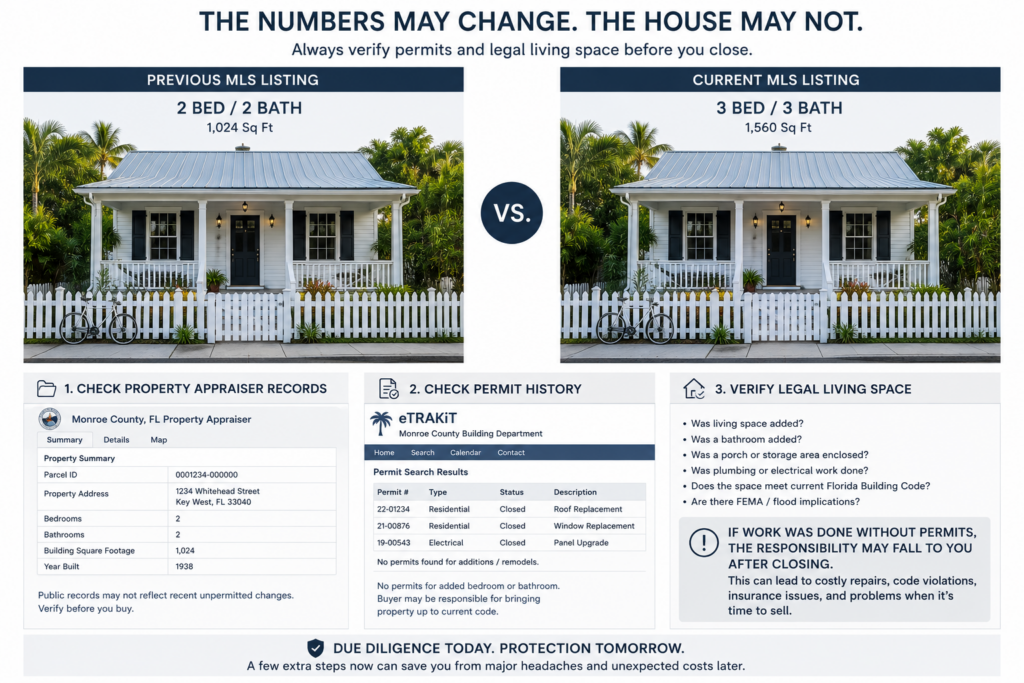
Here is a simple example.
A house sold a few months ago as a 2-bedroom, 2-bath home. It is now being marketed as a 3-bedroom, 3-bath home.
That does not automatically mean something is wrong. But it does mean someone should ask:
- When was the extra bedroom added?
- When was the extra bathroom added?
- Was the work permitted?
- Was it inspected?
- Does the Monroe County Property Appraiser record match the listing?
- Do the building records support the current configuration?
- Was uninhabitable space converted into living space?
That last question matters.
In Key West, it is not unusual to see storage rooms, enclosed porches, lower-level areas, or outbuildings presented as living space. Sometimes those spaces were properly permitted and brought up to code. Sometimes they were not.
The difference is not cosmetic. It can affect value, insurance, financing, safety, and future resale.
Is the finished space actually legal?
This is where buyers get into trouble.
A room can have drywall, flooring, air conditioning, furniture, and a nice photograph in the MLS. That does not automatically make it a legal living area.
Buyers and agents should pay particular attention to:
- Enclosed porches
- Converted storage rooms
- Lower-level enclosures
- Guest cottages created from a former storage space
- Added bathrooms
- Added kitchens or wet bars
- Electrical work
- Plumbing work
- Air-conditioned areas are not reflected in public records
In Florida, building codes are strict for a reason. Electrical, plumbing, structural, floodplain, and mechanical work all matter. Monroe County says its Building Department issues permits with reviews that may include planning, environmental, structural, plumbing, mechanical, electric, floodplain, and fire review.
That is not red tape for the sake of red tape. It is the system meant to protect the property, the owner, and the next buyer.
What happens if work was done without permits?

Here is the uncomfortable truth.
When people do work without permits, there is often a reason. Sometimes it is costly. Sometimes it is speed. The work may not have been approved as proposed. Sometimes, unlicensed people were used because licensed contractors generally cannot simply bypass the permit process.
That does not mean every unpermitted improvement is automatically unsafe. But it does mean the buyer should not assume it is fine.
A finished bathroom without a permit may create issues with:
- Plumbing
- Electrical
- Ventilation
- Flood compliance
- Insurance
- Appraisal
- Resale
- Fire Safety
- Future code enforcement
And if the property changes hands, the new owner may be the one dealing with the consequences.
That is the part buyers often do not understand.
Will the previous owner’s unpermitted addition become my problem?
If a buyer purchases a property with unpermitted work, the prior owner does not necessarily remain responsible for correcting it after closing.
The new owner may be the one required to correct the issue, remove the improvement, or bring the work into compliance.
That can mean:
- Hiring licensed contractors
- Opening permits after the fact
- Removing illegal improvements
- Rebuilding to the current code
- Addressing FEMA/floodplain concerns
- Losing use of the space that was marketed as livable
- Spending far more than expected
This is one of the hidden costs of owning the wrong house in Key West.
A buyer may think they bought a 3/3. Later, they may learn that public records and permits support very different things.
How do I check Monroe County property records?
Buyers should not rely only on MLS remarks, photos, or seller representations.
At a minimum, buyers and buyer’s agents should compare:
- Current MLS listing
- Prior MLS listings
- Monroe County Property Appraiser records
- Building permit records
- Inspection reports
- Survey and elevation information when applicable
- Seller disclosures
- Insurance and flood-related documentation
For properties in the City of Key West, the city’s eTRAKiT system allows registered users to search for permit and project information, and unregistered users to search for basic permit and project information.
For Monroe County permitting, the county provides online permitting services and permit search tools, including tools to search active permits by address or parcel ID and inactive permits by parcel ID.
This is not complicated detective work. It is basic due diligence.
But it has to be done.
What can prior listings tell me about a property?
Prior MLS listings are often one of the easiest ways to spot inconsistencies.
Examples that should trigger questions:
- A prior sale shows 2 bedrooms / 2 baths, but the current listing shows 3 bedrooms / 3 baths
- A multi-unit property was previously listed as 6 bedrooms / 2 baths, but now appears as 6 bedrooms / 6 baths
- A former storage area is now staged as a guest suite or office
- A porch is now enclosed and air-conditioned
- A lower-level area is described as a living space
- A detached structure suddenly appears to function like a guest cottage
Again, none of this automatically proves wrongdoing. But it absolutely means the buyer and the buyer’s agent should investigate.
A good buyer’s agent does not just open doors. A good buyer’s agent helps identify risk.
How does unpermitted work affect flood insurance?
In the Florida Keys, unpermitted work can create problems beyond the building department.
It may affect:
- Wind insurance
- Flood insurance
- Replacement cost assumptions
- Appraisal
- Lender comfort
- FEMA/floodplain compliance
- Future renovation options
Flood-related rules are especially important. A downstairs area, enclosure, or converted space may look useful, but if it does not meet floodplain requirements, it can become a serious problem.
The danger is not just that the space may be noncompliant. The danger is that the buyer may have paid for that space as if it were fully legal, insurable, and usable.
That is a bad place to be.
What does real due diligence look like?
A home inspection is important. But a home inspector is not a permit researcher, zoning attorney, floodplain manager, insurance underwriter, and appraiser all rolled into one.
Due diligence means asking the right questions before the inspection period expires.
It means verifying the property, not just admiring it.
Buyers should ask:
- Does the property appraiser’s record match the listing?
- Do the bedroom and bathroom counts match prior records?
- Do square foot numbers match property appraisers’ records?
- Were additions permitted?
- Were permits closed?
- Was plumbing or electrical work done legally?
- Was an uninhabitable space converted to a living space?
- Does the survey match what is being marketed?
- Are there open or expired permits?
- Are there code issues?
- Will the insurance company recognize the current configuration?
That is the work.
What should a buyer’s agent be checking for me?
This is not just a buyer issue. Buyer’s agents need to be alert.
If a listing has changed dramatically from a prior sale, that is not something to gloss over.
A buyer’s agent should be looking for:
- Bedroom/bath count changes
- Square footage changes
- Newly enclosed areas
- Below-flood living claims
- Detached structures are being used differently
- Prior listing inconsistencies
- Permit gaps
- Appraiser record discrepancies
This is especially important in Key West because the homes are unique, old, frequently modified, and often marketed heavily on charm.
Charm is wonderful. But charm does not replace compliance.
The Bottom Line

Key West is full of extraordinary homes. It is also full of homes that have been changed, patched, expanded, enclosed, upgraded, and reimagined over time.
Some of that work was done properly.
Some of it was not.
The buyer’s job is not to panic. The buyer’s job is to verify.
If a house is marketed today as something different from what it was before, ask why. Check the property appraiser. Check the permits. Compare prior listings. Ask direct questions. Bring in the right professionals before the inspection period ends.
Because after closing, the charming surprise may no longer belong to the seller.
It may belong to you.
I’m Rich Patten—and this is real estate guided by lifestyle.